
What a Pacifica Resident Lookup Can Confirm
One resident lookup can establish a record event, party role, parcel connection, or public affiliation when the source and date are clear. It cannot prove a current residence from one name hit. The coverage table keeps the record question and access route together.
| Record | What it can confirm | Where | Access |
|---|---|---|---|
| Parcel and deed | Recorded interest, APN, legal address, transaction clues | Property Maps and RecorderWorks | Address map; name chain from 1985 |
| Court index | Party name, role, case type, filing date, action trail | MIDX and Odyssey | Nonconfidential, nonsealed matters |
| Vital record | Birth, death, marriage, or divorce event through a copy | County, CDPH, or Superior Court | Authorized or informational rules |
| Business filing | Entity, agent, address, status, and filing history | California bizfile and county FBN | Free search and many PDFs |
| Professional license | License status, public discipline, credential details | DCA and individual boards | Board fields vary |
| Probate or obituary | Decedent, representative, heirs, family, or event lead | Court, Tribune, PHS | Index, clerk file, or archive |
The record that confirms an event may not confirm an address, and the record that confirms a parcel may not confirm occupancy. A sound Pacifica resident lookup states exactly what the source proves.
Build a Pacifica Resident Lookup
Begin with the strongest clue already in hand. A full name with an old address is more useful than a name alone. An approximate age, middle initial, relative, occupation, school, community name, or case date can separate people with the same spelling. When the clue is an address, use the county parcel map to obtain the APN and legal description, then pivot to recorded parties. When the clue is a case, start with the party index and capture the role before reading the result as a person fact.
Compare at least two independent details: a date with an address, a party role with a related name, or a business filing with a separate public license record. A mailing address may be stale or nonresidential. A vital informational copy can establish an event without proving the identity of the requester. A custody or registry result has its own statutory scope. The purpose is careful matching, not a larger pile of names.
RecorderWorks is the county name-index route when an address leads to a recorded party.
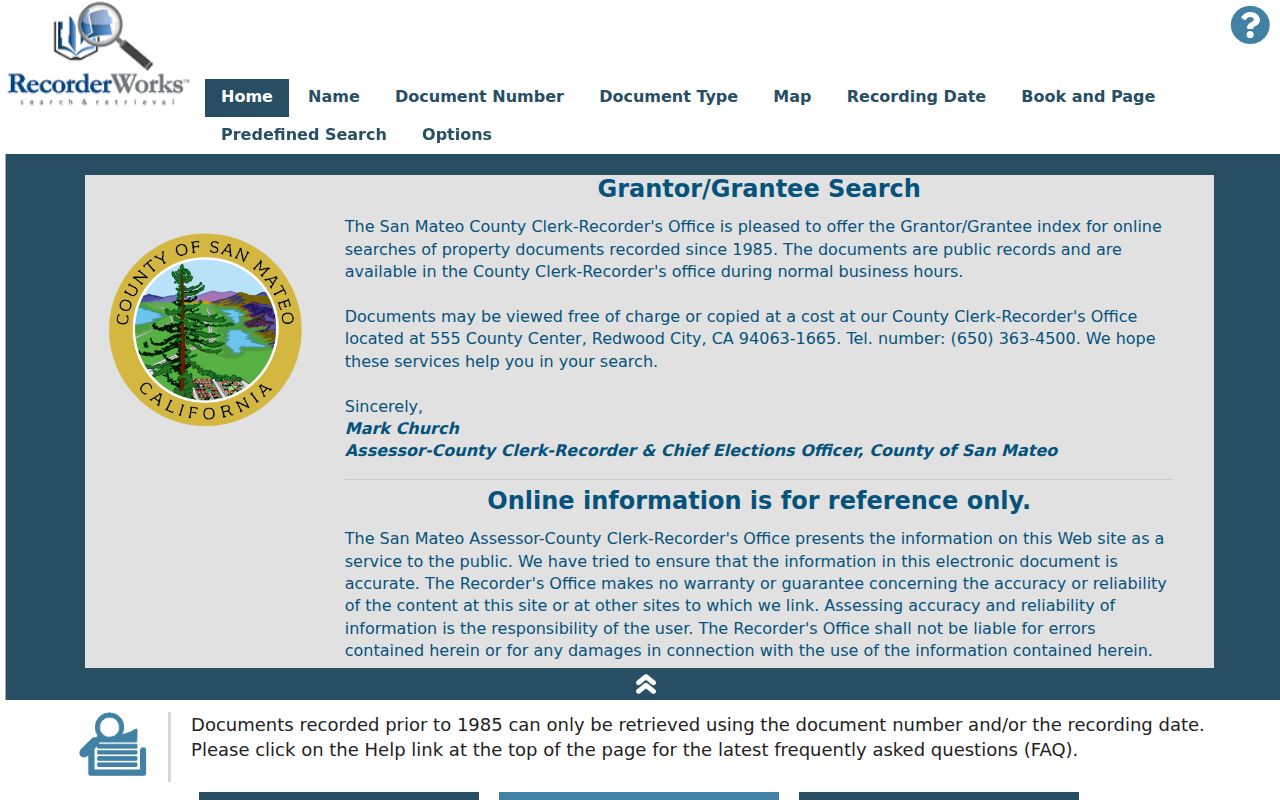
The index can connect a name to recorded instruments from 1985 forward, but the APN, dates, and legal description still have to match.
A street question belongs in the Pacifica street directory address workflow when the goal shifts from one person to the parcels around an address.
Pacifica Resident MIDX Search
Pacifica cases are handled by San Mateo Superior Court. MIDX searches nonconfidential and nonsealed civil, criminal, family, probate, and small-claims indexes. Use a broad, brief party name first, then capture case number, party type, case name, file date, and index source. Criminal cases filed before 1993 require the Criminal Clerk at 650-261-5100 option 1.
Odyssey Public Portal needs no public registration. Its Smart Search accepts a party name or case number, and an asterisk wildcard can broaden a business or name variant such as Generic Co*. The court's Odyssey portal notes explain public content and exclusions. Advanced filters exist, but the complete dropdown list was not verified. Registers of actions and some public documents appear for eligible cases. Adoption, juvenile, paternity, mental-health, sealed, and confidential matters are excluded or restricted.
The official court access route is San Mateo Superior Court's online case access.
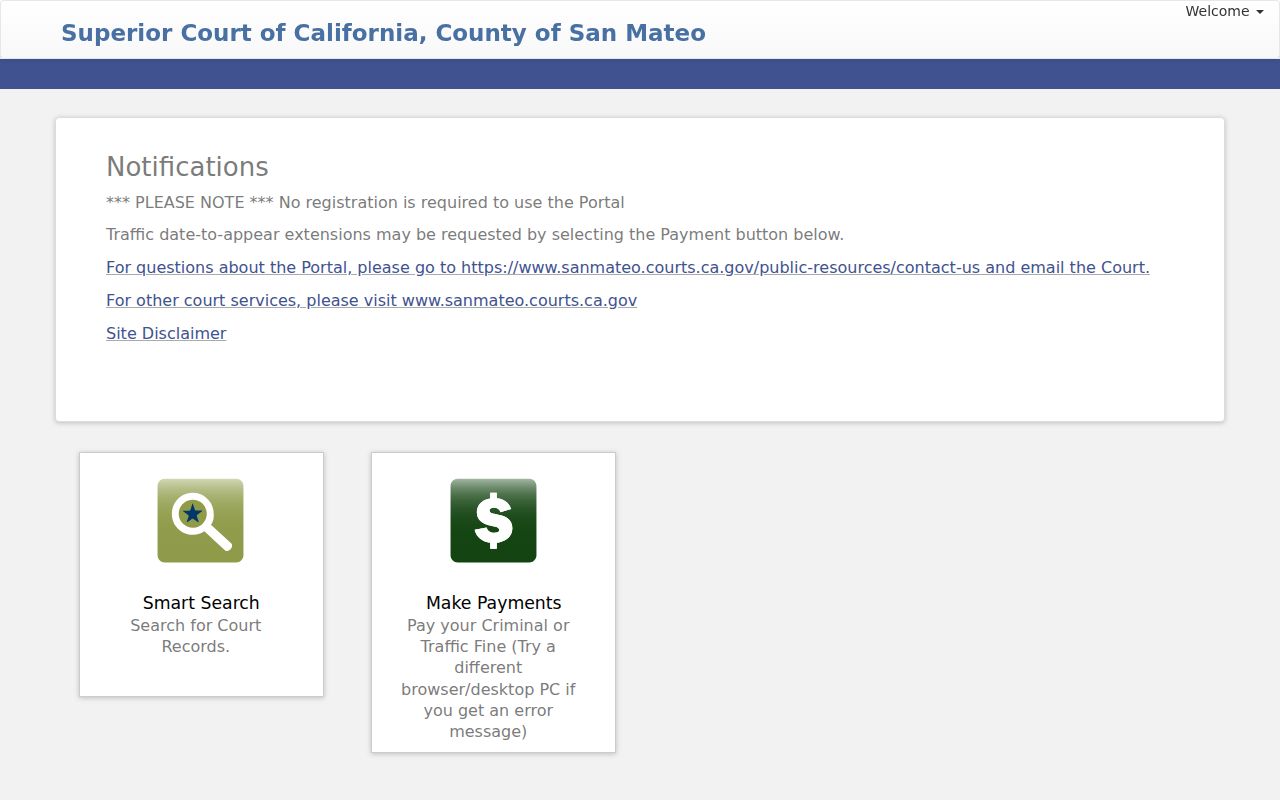
The image shows the public Smart Search route. An index result is not the official court file, and a missing web result is not proof that no case exists.
| Case number | Use when the number is known for a direct route. |
|---|---|
| Party name | Search broadly, then compare variants and role. |
| Case filing date | Narrow a common name or test a time period. |
| Result fields | Case name, party type, file date, index source, register events, and eligible documents. |
Pacifica Resident Court Files
The Hall of Justice Records Management counter in Room A at 400 County Center, Redwood City, is the fallback when a public file is not displayed remotely. Public criminal, civil, small-claims, family, probate, and unlawful-detainer files can be viewed Monday through Friday from 8:30 a.m. to 1 p.m.; an appointment route is available. Up to five files may be reviewed at one time. Off-site retrieval is $10 per file, generally available within 72 hours, and held for five working days.
Mail requests need a case number, parties, approximate filing date, document description, stamped envelope, and a blank check marked with a not-to-exceed amount. The court reports a response within 30 days and does not research for the requester. Copy service is $0.50 per side, certification of a paper or proceeding is $40, and a search over ten minutes is $15. Those fees are for court services, not a fee to run the public index.
A Pacifica resident lookup should say whether it found an index entry, an accessible register, or a clerk-held document. The distinction matters for a name that appears in several cases.
Records counter hours, mail instructions, and copy routes are listed by San Mateo Superior Court Records Management.
Pacifica Resident Vital Copies
California uses authorized and informational certified copies rather than a simple rule that every birth is closed for 100 years or every death for 50. Health and Safety Code sections 103525-103526 govern access. An authorized copy requires an eligible requester and sworn statement. An informational certified copy can be available to another requester, but it is marked informational, cannot establish identity, and may redact fields. A confidential marriage certificate is ordinarily limited to a party or other lawful authorization.
San Mateo County can issue county birth, death, and marriage records. CDPH supplies statewide vital records, while a divorce decree comes from Superior Court. CDPH public-marriage holdings cover 1905-1999, 2001, and 2008-2025; the county may be the route for 2000 and 2002-2007. CDPH does not hold confidential marriages. No official public California web name index for all births, deaths, and marriages was located.
| Record | Route | 2026 fee in research | Key limit |
|---|---|---|---|
| Birth | County, local registrar, or CDPH | County $34; CDPH $31 | Authorized or informational copy |
| Death | County, local registrar, or CDPH | $26 | Informational copy redacts signature and SSN |
| Public marriage | County where license issued or CDPH | $19 | State holdings have year gaps |
| Confidential marriage | County Clerk where license issued | $19 | Party or legal authorization |
| Divorce | Superior Court decree or CDPH certificate | CDPH certificate $18 | Certificate is not the decree |
The California vital-records page supplies the state route. The CDPH fee schedule and current processing notes should be checked before mailing a form. Fees are retained as a search fee if no record is found.
Pacifica Resident Business Records
When a resident has a public business or licensed role, those records can add a useful independent anchor. California bizfile accepts an entity name or file number, has advanced filters for type, status, and initial filing date, and offers free filing PDFs. Results can show formation or registration date, standing, jurisdiction, street and mailing addresses, agent for service, filing history, and a Statement of Information due date. The Secretary of State says it does not collect ownership data, so an agent or officer must not be labeled an owner without supporting evidence.
The DCA license search can use board or bureau, license type, license number, business, first or last name, registry number, city, county, status, discipline, and public documents where available. The CSLB, Medical Board, DRE, and State Bar each have their own scope. San Mateo County FBN filings can connect a business name to principal addresses and registrant types. None of these is a complete resident directory. The state unclaimed-property search is another narrow name, address, city, or property-number route and requires evidence for a claim.
Search the California business portal, then compare the filing date and address with a court, deed, or license result rather than merging names by spelling.
Pacifica Resident Heir Search
An heir search starts with a decedent and a probate case, not a speculative name list. MIDX or Odyssey can identify a probate index entry. The clerk file may hold a petition, personal representative, heirship material, or later succession instrument. A recorded deed can show a transfer, while an obituary or Pacifica Tribune notice supplies relatives, organizations, and place clues. Each source has a different level of proof.
San Mateo County Libraries provide newspaper databases, and the Pacifica Historical Society preserves clippings, oral histories, photographs, and local biographies. Search by the decedent's name and community, then verify the relationship in a court or vital record. An obituary is a family lead, not a certified legal statement about title.
When the question is the historical household rather than one current person, follow the Pacifica city directory collection route for newspaper, census, and archive pairings.
Another narrow public system is the California Department of Corrections and Rehabilitation locator.
CDCR results can show name, age, CDCR number, location, admission date, commitment county, parole eligibility, and board actions. It is a custody and status lookup, updated daily and informational, not evidence of current residence.
Pacifica Resident Reunion Route
California's Mutual Consent Program is the lawful route for an adult adoptee and birth parent who want protected contact. Both parties must file consent. Agencies cannot solicit consent or conduct a general search for one party. The program is therefore not an open resident lookup and cannot be replaced by a name search, deed, newspaper entry, or directory result.
California Department of Social Services Post Permanency Services is at 744 P Street, MS 8-12-521, Sacramento, with the research file listing 916-651-8089. Use the program's official instructions and eligibility path when the goal is birth-family reunion. A public record may supply history, but it cannot provide the consent that the program requires.
This is a human-use case for careful research: the right result is a protected reunion process, not the broadest possible collection of personal details.
Verify Pacifica Resident Records
Verification means anchoring a name to a record event, then testing that result against another custodian. Start with the known address or strongest identifier. Do not use a deed as proof of occupancy, and do not use a court index as proof of guilt or current location.
- Write down the exact name, variants, approximate age, relative, former address, and date range.
- Resolve a known address to APN and legal description in Property Maps.
- Search RecorderWorks for the latest grantee and capture document number, date, and party roles.
- Search MIDX broadly, then run the exact case number in Odyssey and compare related parties and dates.
- Use business, license, vital, obituary, or probate records only when their fields independently match.
- Obtain a clerk-held or certified copy when the event must be proved, and note every excluded or unavailable source.
A result inventory makes the verification auditable:
- Party name and role, case number, case type, and file date
- APN, legal description, recording date, document type, and grantor or grantee role
- Vital record type, copy category, date, place, and custodian
- Business entity, agent, filing date, address, status, or professional license fields
- Docket
- The court's running case record of filings, hearings, and events.
- Index versus image
- An index points to a record; an image or clerk copy is the underlying document.
- Certified copy
- A custodian-issued copy with certification that carries a different evidentiary weight from a screen result.
Do not collapse several partial matches into one identity. A Pacifica resident lookup is strongest when it records uncertainty and tells the reader which office can resolve it.
Pacifica Resident Lookup Boundaries
California limits access to voter files, confidential marriages, sealed and confidential court categories, criminal-history summaries, DMV data, and protected addresses. Safe at Home applicant guidance explains the substitute mailing address available to eligible survivors and qualifying household members, while the program's governing laws set its limits. A no-result can therefore reflect a legal shield, not an absence of a person or event.
California privacy rights and DROP can apply to qualifying data brokers, but they do not compel a recorder or court to erase a lawful public record. The Secretary of State's voter-access regulations explain permitted fields and uses. If a record is wrong, contact its custodian: the court clerk for a court file, ACRE for a recorded instrument, CDPH or the county for a vital copy, CDCR for a custody record, or the relevant board for a license.
Lawful personal use. Use a resident lookup for family history, lawful record correction, civic understanding, or a respectful reunion. Do not use it to stalk, harass, intimidate, or harm anyone, and do not republish protected information.
The federal court route can be useful for a different record system. PACER searches Northern District of California cases by party, case number, or date; the federal court controls its own electronic case route. It is separate from San Mateo Superior Court.
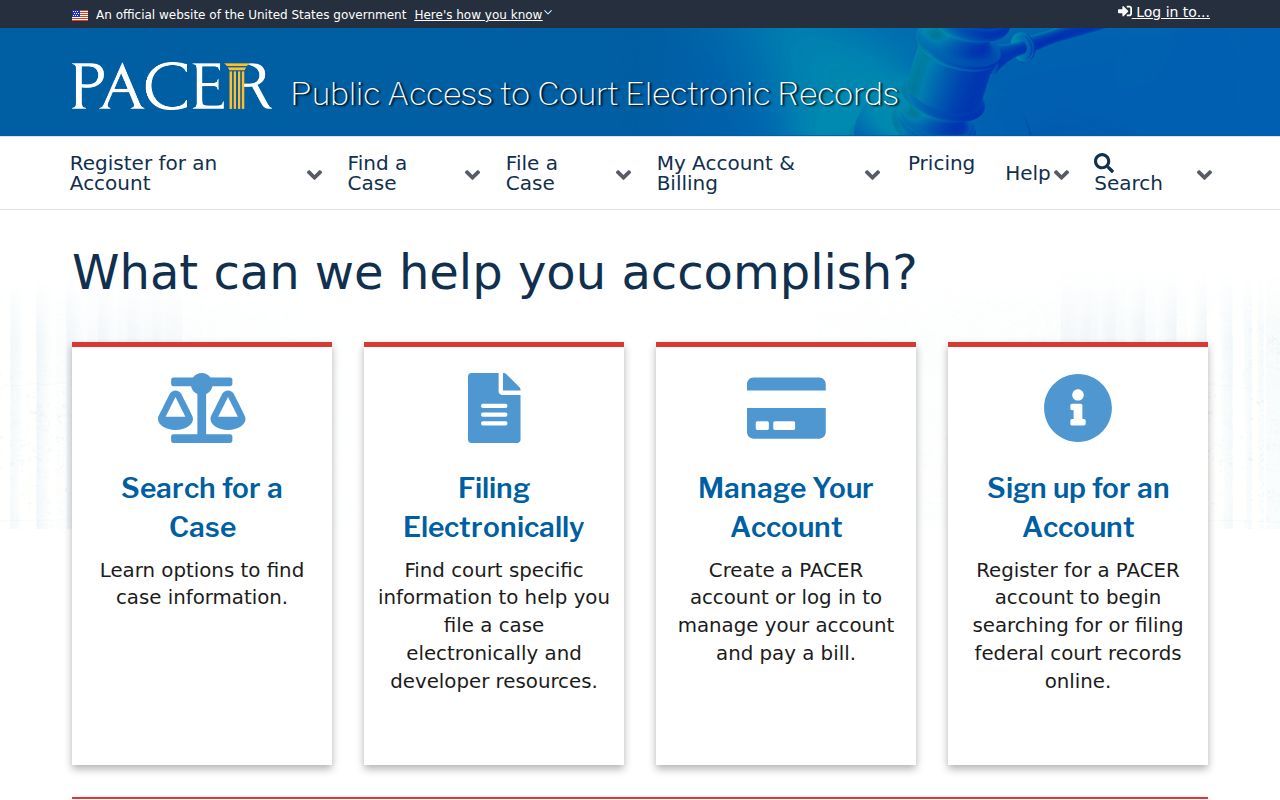
PACER charges by page, caps most case reports and documents at $3, and waives quarterly totals of $30 or less. A federal docket is an official route for that court, but it remains only one piece of a careful Pacifica resident lookup.